
Achieve Practice Growth: Direct Mail Solutions with SmartleadsUSA & Smartzone Mailings
Introduction: Unlocking Practice Growth in a Competitive Landscape
In today’s competitive landscape, growing a professional practice, whether in dentistry, healthcare, or another specialized industry, requires a marketing strategy that cuts through the digital clutter. While online advertising dominates conversations, a powerful and often overlooked opportunity lies in a proven, tangible channel: direct mail. The challenge is moving beyond generic mailings to a data-driven, intelligent approach that delivers measurable results. Many practice owners struggle to identify the right audience, craft a compelling message, and track the return on their investment, leaving potential growth untapped.
This article explores how a strategic partnership with SmartleadsUSA and SmartZone Mailings can transform your direct mail efforts from a guessing game into a precision-guided engine for patient and client acquisition. We will delve into why direct mail is experiencing a resurgence, how to leverage data for hyper-local targeting, and the specific programs designed to capture new business and foster long-term loyalty.
The Challenge of Modern Practice Marketing
The modern marketing environment is saturated. Potential patients and clients are bombarded with digital ads, emails, and social media content, leading to banner blindness and inbox fatigue. For a local practice, standing out in this crowded digital space is a significant hurdle. Gaining the attention and trust of a potential new customer requires a marketing touchpoint that is personal, memorable, and directly relevant to their needs, a combination that digital channels often struggle to deliver consistently.
Why Direct Mail: A Proven Path to Patient & Client Acquisition
Direct mail offers a unique solution to digital saturation. It provides a physical, tangible connection with a potential patient or customer in their own home, a space where marketing messages are less frequent and more likely to be considered. A well-designed mailer can capture attention in a way an email cannot. This channel has consistently demonstrated high response rates when executed correctly, making it a reliable pillar for any practice growth strategy focused on acquiring new, high-value clients.
Introducing SmartleadsUSA & SmartZone Mailings: Your Strategic Partner
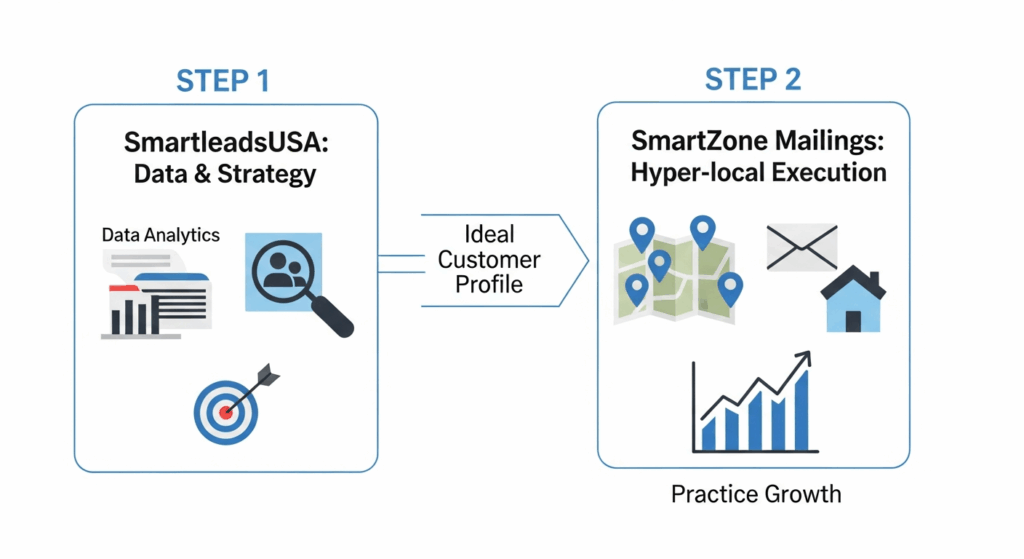
The SmartleadsUSA and SmartZoneMailings partnership: A two-step process from data-driven strategy to precision-targeted execution.
SmartleadsUSA and SmartZone Mailings represent the evolution of direct mail marketing. They combine decades of industry expertise with sophisticated data analytics and precision targeting technology. SmartleadsUSA provides the strategic foundation, leveraging comprehensive data research and insights to identify the ideal customer for your practice. SmartZone Mailings then executes with hyper-local precision, ensuring your message reaches the right households in the right neighborhoods for maximum impact and minimal waste. Together, they offer an end-to-end solution designed to turn your marketing investment into tangible practice growth.
The Resurgence of Direct Mail: Why it Works in a Digital-First World
While it may seem counterintuitive, the rise of digital marketing has made direct mail more effective than ever. As consumers become desensitized to online ads, a physical piece of mail stands out, offering a welcome break from screen time and creating a lasting impression.
Cutting Through the Digital Noise: The Tangibility Advantage
A physical mailer, whether it’s a vibrant postcard or a professional letter, engages the senses in a way a digital ad cannot. It has weight, texture, and a physical presence in a customer’s home. This tangibility makes the marketing message feel more real and substantial, creating a stronger connection to your practice. Unlike an email that can be deleted with a single click, a direct mail piece often remains in the home for days, providing multiple opportunities for engagement and consideration.
Higher Engagement and Brand Recall: Beyond the Inbox
Research consistently shows that direct mail drives higher engagement and brand recall than its digital counterparts. Consumers are more likely to read and remember information presented in a physical format. This is because the brain processes physical media differently, resulting in a deeper emotional response and improved memory retention. For a practice aiming to build a trusted local brand, this enhanced recall is a significant advantage, ensuring your business is top-of-mind when a potential patient needs your services.
Validating Effectiveness: Insights from FRESH Research and Industry Trends
The effectiveness of direct mail isn’t just anecdotal. Comprehensive studies, such as the Canada Post-endorsed FRESH research, provide neurological evidence supporting its power. The research found that direct mail is easier for the brain to process and performs better in terms of brand recall. Across the marketing industry, data shows that well-targeted direct mail campaigns often yield response rates that surpass those of email, display ads, and paid search, confirming its status as a high-performing channel.
Accessibility for Small-Business Owners: Competing with Big-Budget Companies
Direct mail levels the playing field, allowing local practices to compete effectively with larger corporations. While national brands may have massive digital advertising budgets, a hyper-local direct mail campaign allows a smaller business to dominate its immediate market. By focusing marketing efforts on specific, high-potential neighborhoods, a practice can achieve a high share of voice and build strong community recognition without needing an enterprise-level budget.
The SmartleadsUSA & SmartZone Mailings Difference: Data, Personalization, and Integration
The key to a successful direct mail campaign is not just sending mail, it’s sending the right mail to the right people. This is where the strategic intelligence of SmartleadsUSA and the precision of SmartZone Mailings combine to create an unbeatable advantage.
Precision Targeting with Data-Driven Research & Insights
SmartleadsUSA begins every campaign with deep-dive research. Using advanced data modeling, they analyze demographic, psychographic, and behavioral data to build a detailed profile of your ideal patient or customer. This process extends beyond simple age and income metrics to reveal nuanced insights into lifestyle, purchasing habits, and specific needs. This data-driven approach ensures that your marketing budget is spent targeting only the most qualified prospects, dramatically increasing the potential for a positive response.
My Personalized Offerings Platform: Tailored Campaigns for Maximum Impact
Leveraging the rich data insights from their research, the My Personalized Offerings platform allows for the creation of highly tailored mailers. This technology enables variable data printing, meaning elements of the design, copy, and offer can be customized for different segments within a single campaign. A family in one neighborhood might receive a postcard promoting pediatric services. At the same time, an older demographic in another area sees an offer for a different specialized service, all within the same mailing. This level of personalization makes the message more relevant and compelling, driving higher response rates.
Bridging Physical and Digital: Integrated Campaign Strategies
Modern direct mail is not an isolated channel. SmartleadsUSA and SmartZone Mailings excel at creating integrated campaigns that bridge the physical and digital worlds. By incorporating elements like QR Codes, personalized URLs (PURLs), and call tracking numbers, each mail piece becomes a direct gateway to your online presence. A recipient can scan a QR Code to instantly book an appointment, visit a custom landing page, or watch a video about your practice. This seamless integration enhances the customer journey and provides invaluable tracking data.
Core Direct Mail Programs for Sustained Practice Growth
To meet the diverse needs of different practices, SmartleadsUSA and SmartZone Mailings offer a suite of specialized direct mail programs, each designed to achieve specific marketing objectives.
New Mover Mailings: Capturing Patients and Clients from Day One
New movers are one of the most valuable audiences for any local business. They are actively seeking new service providers, from dentists and doctors to veterinarians and financial advisors. New Mover Mailings target these individuals within days of their arrival, placing your practice front and center at the exact moment they are making purchasing decisions. This program offers an unparalleled opportunity to establish a loyal customer relationship from the outset.
Radius Marketing Campaigns: Concentrated Marketing for Local Impact
For practices that draw clients from their immediate vicinity, a Radius Marketing Campaign is a highly effective strategy. This program targets every viable household within a specific geographic radius around your business location. It’s an ideal way to build strong local brand awareness and ensure that everyone in your community is aware of the services you offer, driving foot traffic and local engagement.
Saturation Mailings: Maximizing Local Reach Where It Matters
Saturation Mailings offer the most cost-effective way to reach a broad audience within targeted postal carrier routes. This approach is perfect for promoting grand openings, special events, or general practice awareness campaigns where maximizing reach is the primary goal. By saturating specific neighborhoods, you ensure dominant visibility in the areas most crucial to your business.
Lifecycle Programs: Nurturing Relationships and Driving Retention
Acquiring a new patient is only half the battle; retaining them is key to long-term success. Lifecycle Programs are designed to nurture existing customer relationships through timely, relevant communications. This can include appointment reminders, birthday offers, or educational content. By maintaining a consistent, positive connection, these mailings increase patient loyalty, reduce attrition, and encourage referrals.
Smart Zone Mailings: Hyper-Local Precision for Optimized ROI
Smart Zone Mailings represent the pinnacle of targeted direct mail. This program combines the best of radius and saturation strategies with the deep data insights from SmartleadsUSA. It allows you to select specific micro-zones or neighborhoods based on the demographic and behavioral profiles that best match your ideal patient. This hyper-local approach eliminates waste and focuses your marketing dollars with surgical precision, delivering an optimized return on investment.
Crafting Your Message: Design, Content, and Offers for High Response
A successful direct mail campaign depends on more than just accurate targeting; the mailer itself must capture attention and inspire action. The design, content, and offer work in concert to convert a prospect into a new patient or customer.
The Art of Direct Mail Design: From Postcards to Mailers
Effective direct mail design is a science. It uses a clear visual hierarchy, compelling imagery, and bold headlines to convey the core message in seconds. Whether using concise postcards for a quick, high-impact message or more detailed mailers for complex services, the design must be clean, professional, and aligned with your practice’s brand. The goal is to create a piece that is visually appealing and easy to read, guiding the recipient’s eye toward the call to action.
Compelling Calls to Action: Guiding Your Customers to Respond
Every mailer must have a clear and compelling Call to Action (CTA). This is the instruction that tells the recipient exactly what to do next. Vague CTAs, such as “Learn More,” are less effective than specific, benefit-driven ones, like “Call Today to Schedule Your Free Consultation” or “Scan to Claim Your 20% Off Welcome Offer.” A strong CTA creates a sense of urgency and makes it easy for the customer to take the next step in their journey with your practice.
The Importance of Quality: Printing, Materials, and Envelopes
The physical quality of your mailer speaks volumes about your practice. A flimsy postcard printed on cheap paper can convey a negative impression before the message is even read. Using high-quality paper stock, vibrant printing, and professional envelopes signals that your practice values quality and attention to detail. This investment in materials enhances credibility and ensures your marketing piece makes the best possible first impression.
Measuring Success: Tracking ROI and Optimizing for Continuous Growth
One of the most significant advancements in direct mail is the ability to track results with digital-level precision. This allows you to measure the direct impact of your campaign on your practice’s bottom line.
Advanced Tracking and Analytics: Understanding Your Response Rates
Modern tracking methods make it easy to measure campaign performance. Unique phone numbers can track calls generated by the mailer, QR Codes can monitor digital engagement, and custom URLs can track website visits. This data provides clear insights into your response rates, allowing you to see exactly how many prospects are engaging with your marketing and which offers are resonating most.
Strategic Client Acquisition Cost Analysis: Proving Your ROI
By tracking the response, you can calculate your exact client acquisition cost (CAC) for the campaign. By comparing the total cost of the mailing to the number of new patients or clients it generated, you can determine a clear return on investment (ROI). This data-driven analysis shifts marketing from a business expense to a quantifiable investment in growth, enabling more intelligent budget allocation in the future.
The Power of Feedback: Incorporating Surveys and Customer Insights
A direct mail campaign can also serve as a valuable tool for gathering customer insights. By directing recipients to a short online survey via a QR Code, you can collect feedback on your services, branding, and offers. This information is invaluable for refining your marketing messages and improving the overall patient experience, creating a virtuous cycle of continuous improvement.
Who Benefits? Ideal Practices for SmartleadsUSA & SmartZone Mailings
While this data-driven direct mail approach can benefit nearly any local business, it is particularly effective for practices that rely on building a base of local, high-value clients.
Dental Practices: Specialized Direct Mail for Patient Acquisition (e.g., Dentists)
The dental industry is a prime example. Acquiring a new patient represents a significant lifetime value. Using Smart Zone Mailings, a dentist can target neighborhoods with a high concentration of families for pediatric and general dentistry services, or focus on more affluent areas to promote cosmetic services such as implants or veneers. A New Mover campaign is especially critical, as it captures new families before they establish a relationship with a competitor. By sending a high-quality, professional mailer with a compelling introductory offer, a dental practice can build a steady stream of new patients and achieve sustainable growth.
Conclusion
In an era of digital overload, strategic direct mail provides a powerful means for practices to establish genuine connections with potential patients and clients. The key to unlocking this potential lies in moving beyond outdated “spray and pray” methods and embracing an intelligent, data-driven approach. The synergistic solution offered by SmartleadsUSA and SmartZone Mailings provides the framework for this success. By combining deep market research, precision hyper-local targeting, personalized messaging, and robust tracking, they transform direct mail into a predictable and highly effective engine for practice growth.
For any practice owner serious about expanding their client base and dominating their local market, now is the time to re-evaluate the role of direct mail in your marketing mix. By partnering with experts who can architect a campaign tailored to your unique business goals, you can cut through the noise, engage your ideal customer, and achieve measurable results that directly contribute to your bottom line.